The nurses who are planning to apply for Nursing Officer posts or have already applied are requesting previous question papers, sample question papers, and study materials. You can find a wealth of study materials at www.nursingwork.in and www.nursingwrittentestquestions.blogspot.com.
Here, we have published sample questions collected from various recruitment examination papers. You can also refer to question papers from:
These resources may be helpful in preparing for the Computer Based Test (CBT) for Staff Nurse Recruitment by PGIMER.
Here are some PGIMER Nursing Officer Exam Sample Questions with Answers. Candidates can use these questions for practice and exam preparation. Click “Show Answer & Explanation” to view the correct answer and reasoning.
1. Smallest bone in the human body is:
- (a) Stapes
- (b) Incus
- (c) Malleus
- (d) Femur
👉 Show Answer & Explanation
Answer: A
Explanation: The stapes, located in the middle ear, is the smallest bone in the human body. It helps transmit sound vibrations to the inner ear.
Explanation: The stapes, located in the middle ear, is the smallest bone in the human body. It helps transmit sound vibrations to the inner ear.
2. If there is blood in sputum, it indicates:
- (a) Hemoptysis
- (b) Hyperpyrexia
- (c) Diarrhoea
- (d) Pyorrhea
👉 Show Answer & Explanation
Answer: A
Explanation: Hemoptysis refers to coughing up blood or blood-stained mucus from the respiratory tract.
Explanation: Hemoptysis refers to coughing up blood or blood-stained mucus from the respiratory tract.
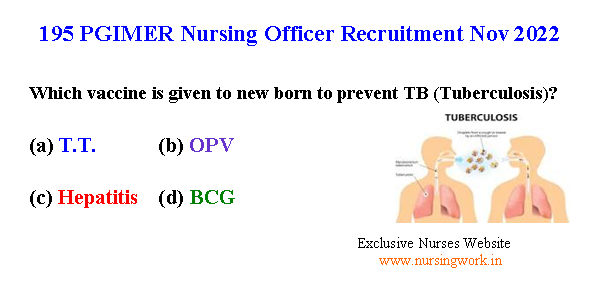
3. Which vaccine is given to newborns to prevent TB?
- (a) T.T.
- (b) OPV
- (c) Hepatitis
- (d) BCG
👉 Show Answer & Explanation
Answer: D
Explanation: The BCG (Bacillus Calmette-Guérin) vaccine is given to newborns to protect against tuberculosis.
Explanation: The BCG (Bacillus Calmette-Guérin) vaccine is given to newborns to protect against tuberculosis.
4. Indian Red Cross Society was established in the year:
- (a) 1920
- (b) 1950
- (c) 1864
- (d) 1913
👉 Show Answer & Explanation
Answer: D
Explanation: The Indian Red Cross Society was established in 1913 and is part of the International Red Cross and Red Crescent Movement.
Explanation: The Indian Red Cross Society was established in 1913 and is part of the International Red Cross and Red Crescent Movement.
5. Folic acid is present in:
- (a) Pulse
- (b) Fresh fruits
- (c) Milk
- (d) Liver oil
👉 Show Answer & Explanation
Answer: A
Explanation: Folic acid is abundantly found in pulses (legumes), leafy vegetables, and some fruits. It is essential for DNA synthesis and red blood cell formation.
Explanation: Folic acid is abundantly found in pulses (legumes), leafy vegetables, and some fruits. It is essential for DNA synthesis and red blood cell formation.
6. Causative organism of Diarrhoea is:
- (a) Ritro virus
- (b) Rota virus
- (c) Plasmodium vivax
- (d) None of these
👉 Show Answer & Explanation
Answer: B
Explanation: Rotavirus is the most common causative organism of diarrhea in infants and young children.
Explanation: Rotavirus is the most common causative organism of diarrhea in infants and young children.
7. Powerhouse of a cell is called:
- (a) Mitochondria
- (b) Ribosome
- (c) Plasma
- (d) Endoplasmic reticulum
👉 Show Answer & Explanation
Answer: A
Explanation: Mitochondria are known as the powerhouse of the cell because they produce energy in the form of ATP.
Explanation: Mitochondria are known as the powerhouse of the cell because they produce energy in the form of ATP.
8. pH value of blood is:
- (a) 7.4
- (b) 5.6
- (c) 0
- (d) 6
👉 Show Answer & Explanation
Answer: A
Explanation: Normal blood pH is 7.35–7.45, which is slightly alkaline.
Explanation: Normal blood pH is 7.35–7.45, which is slightly alkaline.
9. DOTS therapy is given for:
- (a) STDs
- (b) TB
- (c) Malaria
- (d) Polio
👉 Show Answer & Explanation
Answer: B
Explanation: DOTS (Directly Observed Treatment, Short-course) is the WHO-recommended TB treatment strategy.
Explanation: DOTS (Directly Observed Treatment, Short-course) is the WHO-recommended TB treatment strategy.
10. Which vitamin is responsible for blood clotting?
- (a) Vitamin A
- (b) Vitamin B
- (c) Vitamin C
- (d) Vitamin K
👉 Show Answer & Explanation
Answer: D
Explanation: Vitamin K is essential for the synthesis of clotting factors and is critical for blood coagulation.
Explanation: Vitamin K is essential for the synthesis of clotting factors and is critical for blood coagulation.
Disclaimer: The PGIMER Nursing Officer Exam Sample Questions and Answers provided on this page are for educational and practice purposes only.
Candidates should verify details, syllabus, and exam pattern with the official PGIMER website or the latest notification. This content does not guarantee selection or official exam results.
Answers for the Above Questions
Question No. 1 Option A
Question No. 2 Option A
Question No. 3 Option D
Question No. 4 Option A
Question No. 5 Option B
Question No. 6 Option B
Question No. 7 Option A
Question No. 8 Option A
Question No. 9 Option B
Question No. 10 Option D
Comments
Post a Comment